

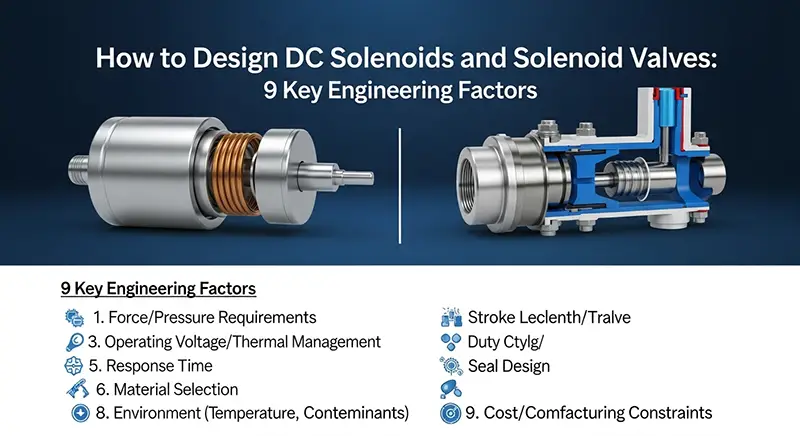
As an elite DC solenoid and solenoid valve manufacturer, Weilong Technology offers valuable information on designing high-performance and dependable solenoid solutions. A good solenoid design integrates well with electrical, mechanical, and environmental parameters. This topic further explores 8 key considerations that must be addressed to ensure success in your solenoid system.
Chapter 1: Motion Type & DC Solenoid Selection
Choosing the correct motion is foundational to electromagnetic system efficiency.
| Type | Description | Best For | Advantages | Disadvantages |
| Open Frame | Controlled stroke operation. | Circuit breakers, scanners, camera shutters. | Compact, precise, AC/DC compatible. | Less durable under high force. |
| Holding | Force concentrated at plunger center via rapid magnetic field change. | Intermittent holding tasks. | Fast response, energy-efficient. | Limited force distribution. |
| Latching | Open-frame + permanent magnet; holds position without power. | Battery-powered devices, energy-saving apps. | Zero power hold, reduces coil burnout. | Higher cost; magnetic interference possible. |
| Tubular | Linear push/pull; enclosed structure. | Ignition systems, electric locks, industrial actuators. | High force, longer stroke, robust. | Larger size, complex manufacturing. |
| Rotary | Converts linear to rotary motion via grooved disc. | Automation, indexing, valve actuation. | Precise rotational control. | More complex design, higher cost. |
| Solenoid Valve | Automated fluid flow control. | Pneumatic, hydraulic, irrigation, HVAC. | Precise control, versatile. | Needs sealing/maintenance; sensitive to impurities. |
Chapter 2: DC Solenoid and Solenoid Valve Size & Mounting Design Considerations
selection of the proper DC solenoid or solenoid valve is far from simply selecting an optimal voltage. Size and mounting design, stroke, operating force, operating environment, and installation space are all factors which have to be taken into account for the reliable operation of a device. Incorrect choice of the size or inadequate mounting design may result in underperformance, overheating, early wear, vibration, loud noise, or even failure.
This engineer’s guide describes key size and mounting design parameters that should be analyzed by the engineer during the design process of automation equipment, medical devices, industrial machinery, automotive equipment, or smart control systems.
2.1 Why the Size of a Solenoid Matters
Size of the DC solenoid determines:
output force;
stroke;
power consumption;
speed of response;
heat generation;
duty cycle;
lifetime;
installation space.
Larger solenoids have the following properties:
higher magnetic force;
longer stroke;
better heat dissipation.
On the other hand, larger products need:
more installation space;
higher current;
more expensive materials.
Right choice of the balance is important.
Step 1: Find Out the Required Force
The force is the first parameter to estimate.
Common considerations are:
load weight;
friction coefficient;
spring resistance;
safety factor;
dynamic acceleration.
Required force could be calculated using the formula:
Required Force = Load + Friction + Spring Force + Safety Factor
Usually, engineers use the safety factor from 20% up to 50%.
2. 2: Select the Proper DC Solenoid Stroke
Stroke refers to the distance the plunger travels.
Typical DC Solenoid stroke ranges include:
| Solenoid Type | Typical Stroke |
|---|---|
| Mini Solenoid | 2–6 mm |
| Push Pull Solenoid | 5–20 mm |
| Tubular Solenoid | 10–30 mm |
| Heavy Duty Solenoid | 20–50 mm |
Remember: As stroke increases, magnetic force decreases.
A common mistake is selecting a long-stroke solenoid while expecting maximum force across the entire travel distance.
Size:Find out wh
2. 3: Installation Space Availability
Engineers designing machines usually have limited installation space.
Measure:
Width
Height
Length
Direction of cable exit
Connector clearance
Maintenance space
Examples of typical installation restraints include:
Compact medical devices
Electronic locks
Vending machines
Robotics
Electronics for consumers
Specifically designed DC solenoids are commonly developed for unique installation spaces.
2.4 : Vibration and Shock Resistance
Industrial conditions often cause:
Continuous vibrations
Mechanical shocks
Impact loads
Recommendations for design:
Using locking screws
Using thread-locking materials where necessary
Anti-vibration washers
Stronger mounting brackets
Vibration tests during product validation
2.5 : Heat Dissipation Space
Heat greatly influences coil durability.
Should avoid:
Fully enclosed installation without ventilation
Installation close to heat generating parts
Blocking air flow around the coil
Correct ventilation will help:
Improve duty cycle
Improve coil durability
Improve reliability
2.6 : Wiring Direction
Cable routing is often forgotten.
Considerations:
Connector orientation
Bend radius of the cable
Waterproof connectors
Strain relief
Maintenance accessibility
Wrong routing often results in broken wires due to frequent machine movements.
Chapter 3: DC Solenoid Operating Stroke & Force
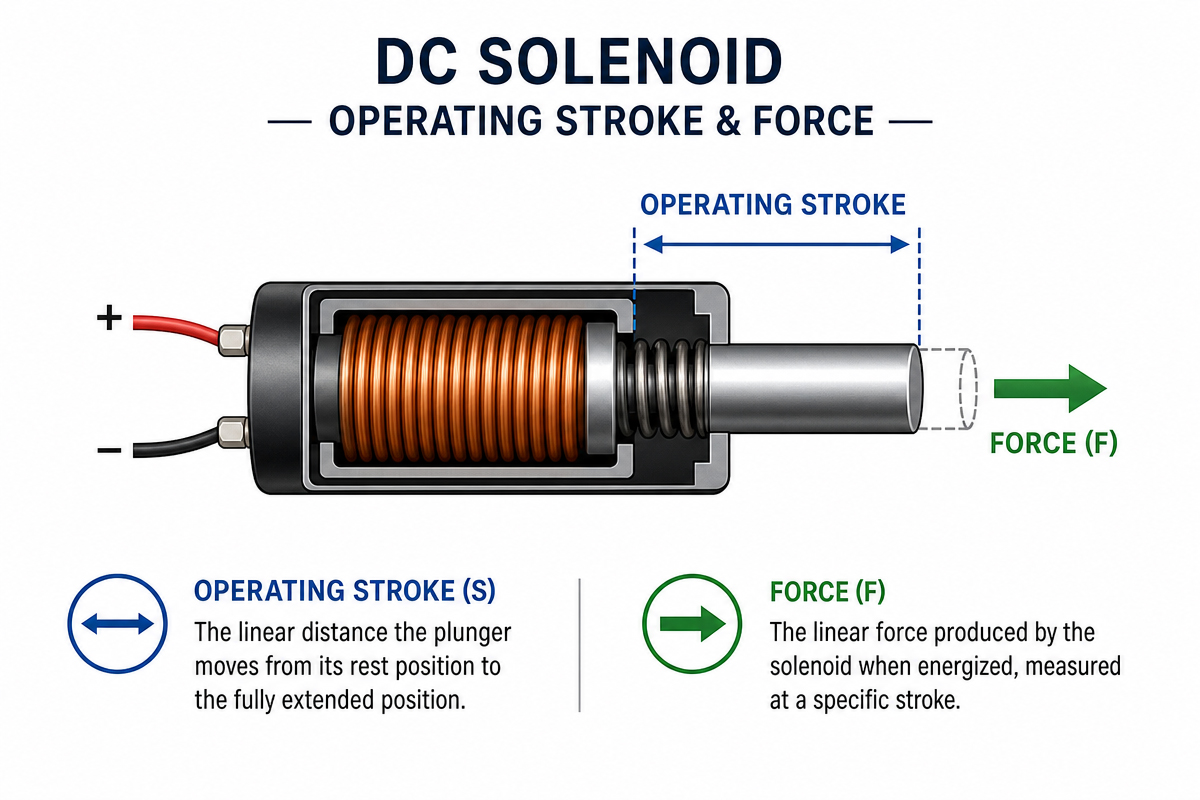
3.1 Operating Stroke & Force of DC Solenoids & Solenoid Valves
Operating stroke and magnetic force are among the most important performance parameters when choosing DC solenoids or solenoid valves. Operating stroke is the travel of the plunger or armature under the action of an excited coil, while magnetic force is the generated magnetic force that moves or holds the load. There is a certain dependence between these parameters – generally speaking, the force reaches its maximum either at the beginning or at the end of the stroke (depending on the type of solenoid) and gradually decreases with an increase in stroke.
In the course of designing a DC solenoid, engineers need to provide a force greater than the load force, friction, and spring resistance as well as an appropriate safety margin. Ignoring these parameters can lead to unreliable solenoid operation, slow responses, or inability to actuate the solenoid.
Regarding solenoid valves, an adequate stroke should ensure opening/closing of the valve and overcoming of the pressure and seal forces. This will positively affect the valve response, energy consumption, and service life.
Collaboration with an experienced solenoid manufacturer will help engineers find the optimal design of the electromagnetic field, coil winding, and plunger to reach an adequate combination of operating stroke, magnetic force, power consumption, and durability.
3.2 Tip:s
The length of strokes should be proportionate to the amount of force. Longer strokes might call for a bigger solenoid.”
Actuation Force: The minimum force required at the longest stroke of the actuator. The actuation force must be
sufficient for the task to be accomplished, but increasing the force may increase the size and
Chapter 4: Duty Cycle & Thermal Management
Duty cycle is one of the most important performance and reliability factors of DC solenoid and solenoid valves. This factor defines the ratio of the time period when the solenoid is energized against the total duration of its full operation. Thus, the 50% duty cycle implies that during the cycle, the solenoid is working at 50%, and the rest of the cycle allows the solenoid to cool down, while the 100% duty cycle means the continuous duty and no limitation of the work period as far as the maximum temperature is not exceeded.
If the solenoid is energized, an electric current flows through the coil of the device causing heat production. The inability to effectively get rid of such heat leads to an increase in the coil temperature, thus damaging the insulation, reducing the magnetic effect, shortening the service life of the product, and even damaging it.
There are many parameters which should be considered by engineers during the solenoid design. They include resistance of the coil, wire diameter, voltage supply, ambient temperature, material of the housing, and ventilation of the solenoid. Such parameters allow balancing magnetic effect and temperature of the solenoid operation.
Choosing the appropriate duty cycle of the device guarantees safe and efficient work of the solenoid.
Chapter 5: Environmental Protection & Surface Treatment
5.1 Key Factors:
Temperature:High temperatures decrease force. Insulation type such as B, F, or H determines maximum operating temp.
Moisture/Dust:IP ratings define the sealing requirements. Methods vary from sealed housings to epoxy potting or use of boots.
Corrosion:“Surface treatments important in humid or chemical environments.”
5.2 DC Solenoid Surface Treatment Options:
Zinc Plating:Standard corrosion resistance.
Nickel Plating:Improved wear and corrosion resistance.
Passivation:For stainless steel components; increases corrosion resistance.
Epoxy/Powder Coating:It creates a thick insulation layer.
Anodized:Aluminum pieces that prevent abrasion and corrosion.
Chapter 6: Lifespan & Durability Characterised by operational cycles.
Usually, durability and lifespan of any solenoid or solenoid valve are estimated by the number of cycles during which the device will function efficiently without breaking down. One operational cycle can be defined as one full energization and de-energization cycle when the plunger moves to its work position and returns to its initial position. According to the specifics of the process and quality of the construction, the lifespan of any solenoid can reach hundreds of thousands or even millions of cycles.
A variety of different factors determine operational life of solenoids. Quality of the windings, magnetic materials, return spring, bearings, and sealing devices make any solenoid durable.
In addition, operational life of the DC solenoid and solenoid valve depends greatly on the conditions of operation. Overloading, overvoltage, excessive temperature, contamination, vibration, wrong installation can drastically decrease the lifetime of any such device. On the other hand, the right choice of voltage, force, stroke and duty cycle can prolong its lifetime.
There is also one more aspect to consider while thinking about operational life of solenoid valves. Type of controlled liquid, operating pressure, fluid purity, and material of sealing devices affect the lifespan too.
Usually, manufacturers of solenoid valves perform many life-cycle tests to make sure that the devices they produce will be durable. These tests imitate the operation conditions of a device in a cycle of repeated energizations and de-energizations at definite electrical load, temperature, etc. Such tests allow making estimates and finding possible ways to increase durability.
An experience manufacturer of solenoids and solenoid valves is highly important for the process that requires long operational life. It provides advanced engineering, precise tooling, quality control and 100% functional tests of each device.
Overall, the correct understanding of operational cycles and right choice of products can save money, reduce downtime and ensure efficient performance of industrial automation systems, automotive devices, medical appliances, security devices, and fluid controls systems.
Chapter 7: Electrical Connections & Integration
| Option | Description | Pros | Cons |
| Lead Wires | Bare tinned copper for soldering. | Simple, reliable. | Requires manual soldering. |
| Insert Pins | Press-fit pins for PCB mounting. | Secure signal integrity. | Less forgiving to misalignment. |
| Terminal Blocks | Screw or crimp terminals. | Easy wiring, high current. | Larger footprint. |
| Connectors | MIL-SPEC, automotive, or custom types. | Modular, quick disconnect. | Adds cost and complexity. |
Chapter 8: Advantage & Disadvantage On DC Solenoid and Solenoid Valve
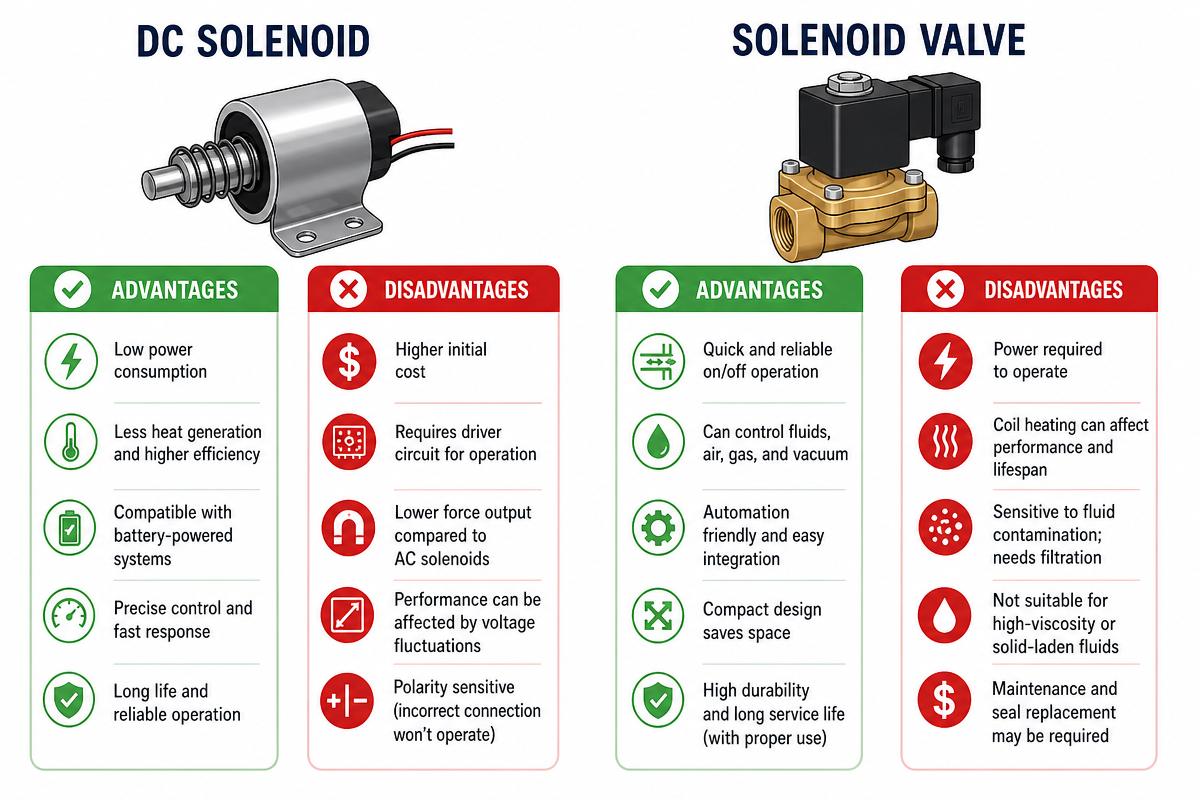
| Feature | Advantages | Disadvantages |
| Open Frame | Compact, precise control. | Less durable in high-force apps. |
| Holding | Fast response, energy-saving. | Limited force distribution. |
| Latching | Power saving, maintains position. | Higher cost, potential magnetic interference. |
| Tubular | High force, robust, longer stroke. | Larger, more complex to manufacture. |
| Rotary | Precise rotational control. | Complex design, higher cost. |
| Solenoid Valve | Precise fluid control, versatile. | Requires sealing/maintenance; impurity sensitive. |
Chapter 9: Mounting Guide on DC Solenoid and Solenoid Valve
Poor mounting can lead to the misalignment of plungers, the generation of friction, the loss of force, the heating of
the coils, or the Typical Solenoid Mounting Techniques
9.1 bracket Mounting
External L-shaped or U-shaped metal brackets Easy installation, simple replacement Common in automation devices and
prototypes Design tips 1 Employ steel or aluminum brackets with appropriate stiffness Where possible, avoid cantilever
mounting to prevent applying a side load
9.2 Frame (Open-Frame )
Solenoid body directly fixed to chassis or plate High rigidity and precise alignment Commonly Used in Printers, Vending
Machines, and Industrial Products Designing Tips Mounting flatness: Ensure flatness to ≤0.05 mm Use all the mounting
holes that have been designed to distribute the load properly. ________________________________________
9.3 Flange Mounting
(Tub Front or Rear Flange with threaded holes Compact, axially load- Typically found in: Valves, Locks, Automotive
actuators Design tips: i The axial force should always be in the direction of the plunger Do not overtighten the screws
to prevent the distortion of the tube Base/foot mounted bases are generally the most difficult Solenoid mounted on the.bottom surface
Recommended for horizontal motion use Usually employed on
special-purpose machines Design tips Add dowel pins or locating features for repeatability Dowel pins or
Isolate vibration if necessary, using rubber pads. For a solenoid, a properly engineered mounting design is a critical
requirement in ensuring reliable and consistent force generation, fast motion, reduced noise, and a longer lifetime. In
particular, attention to mounting requirements can make a very big difference.
Chapter 10:Why Working with an Experienced DC Solenoid and Solenoid Valve Manufacturer Matters
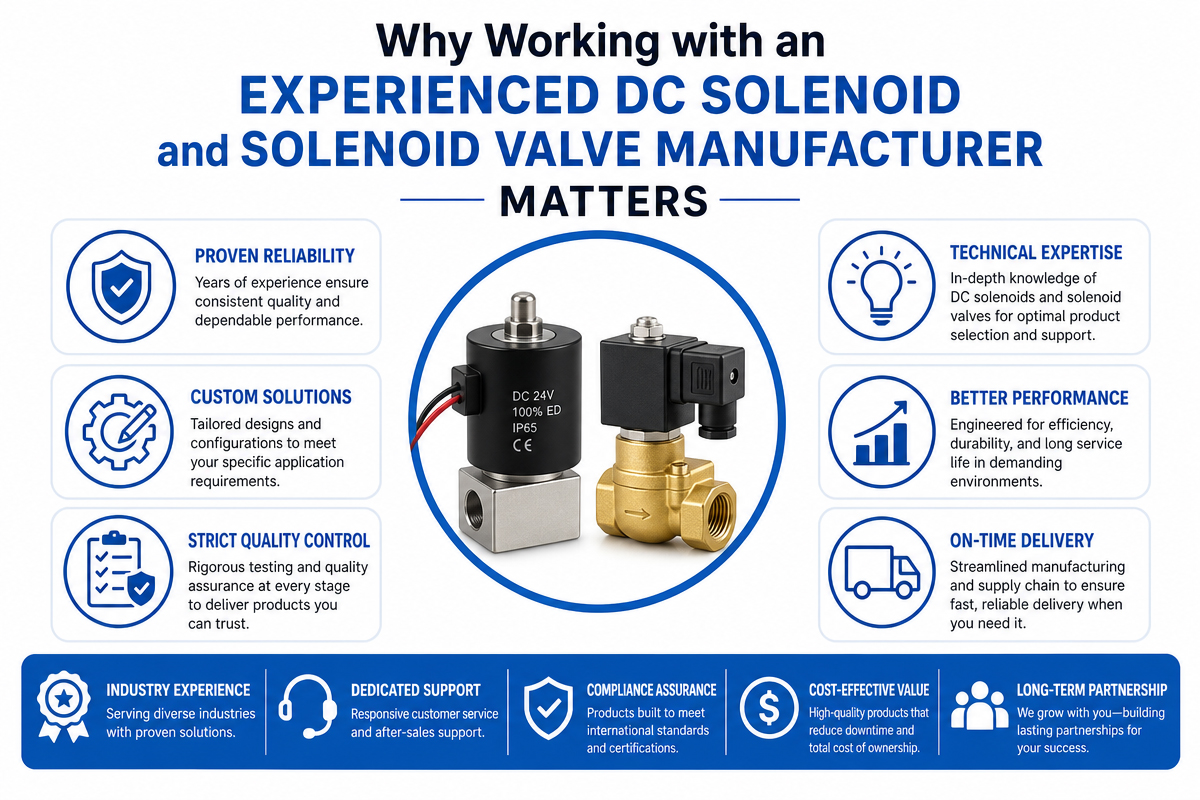
The selection of a DC solenoid and solenoid valve manufacturer plays an important role in ensuring the reliability, effectiveness, and further success of your product. However, although there are many manufacturers able to produce standard parts, an experienced company can provide much more than mere manufacturing abilities; the experience of the engineers will help you reduce risks and speed up the development process of your future product.
Experience means that the manufacturer understands well how electromagnetic force depends on the stroke length, voltage, duty cycle, temperature rise, and response time. As a result, engineers will be able to offer you the best design for your specific operating conditions, rather than providing a ready-to-use part.
Another feature of a good manufacturer is the ability to customize the DC solenoids, push-pull solenoids, rotary solenoids, or solenoid valves to meet your special requirements in any industry. In other words, the DC solenoid manufacturer can create your own unique solution to ensure a shorter development time and optimal performance of your product. No matter what your industry is – medicine, robotics, automobile industry, vending machine systems, door locks, – a professional manufacturer is able to customize your solenoid to the required force, mounting, voltage, sealing level, and lifetime.
Moreover, the quality control is very important in this situation. An experienced manufacturer operates using the quality management system ISO 9001 and possesses the whole in-house production capabilities from tooling design to CNC machining, metal stamping, coil winding, injection molding, assembly, and 100% functional test.
In addition to the above, an experienced manufacturer is able to provide a lot of technical support services during all stages of project realization, from initial concepts and prototypes to testing, optimization, and mass production.
At last, collaboration with an experienced manufacturer can decrease your total ownership cost due to fewer failures, increased reliability of your equipment, reduced downtime, and higher customer satisfaction.
So, when you choose a DC solenoid or solenoid valve manufacturer, you choose not only a component but an experienced engineering partner who is able to turn your innovative idea into reality.
Chapter 11 : FAQs on DC Solenoid and Solenoid Valve
Q1: How do I choose between a tubular and open-frame DC solenoid?
Applications requiring heavy forces over a long stroke are suited for the Tubular Series, while Open Frame machines are
suited for applications requiring a small work
Q2: What are key mounting design tips?
Mounting points must align with the vector of force. Anti-vibration pads or lock washers can be used to prevent
loosening. Heat dissipation routes also need to be considered.
Q3: When is surface treatment necessary?
It should always be specified whether it is intended for humid, corrosive, or outdoor exposure. Nickel plating or epoxy
coating can add substantially to its life.
Q4: Can solenoids work in high temperatures?
Yes, with proper insulation of the coils (such as Class H, up to 180°C) and materials. It is essential to derate for
force when designing for higher temperatures.
Q5: What is the advantage of using a latching solenoid?
Power consumption occurs only during a state change, which makes them ideal for use in battery-operated designs or
designs that are sensitive to power consumption.
Q6: Calculating Duty Cycle</center>
A duty
Equation:Duty cycle (%) = (ON time / (ON time + OFF time)) * 100. It must be matched with the rated duty cycle of the solenoid to
avoid overheating.
Chapter 12 : Conclusion on Design DC Solenoid and Solenoid Valve
Partner for Optimized Design Achieving a robust solenoid or solenoid valve solution involves a complete understanding of motion, force, stroke, cycle rate, operational conditions, mounting considerations, and surface finish requirements. At Weilong tchnolgoy, we have literally decades of experience with complete custom design, engineering, and validation.capabilities to optimize your solution for maximum performance, robustness, and conformance.
Please contact us today for a custom design consultation or for a detailed engineering specification sheet. Full Design Guide for DC Solenoids and Solenoid Valves At Weilong Technology, a trusted and renowned manufacturer of Weilong Technolgoy, we offer key takeaways that can help you design an ideal solenoid system that performs efficiently and accurately. The perfect design takes into consideration various criteria such as electricity, mechanics, and environmental aspects. This article provides an in-depth briefing on 8 key considerations that will result in the success of your project.
